 Sorrento City Guidebook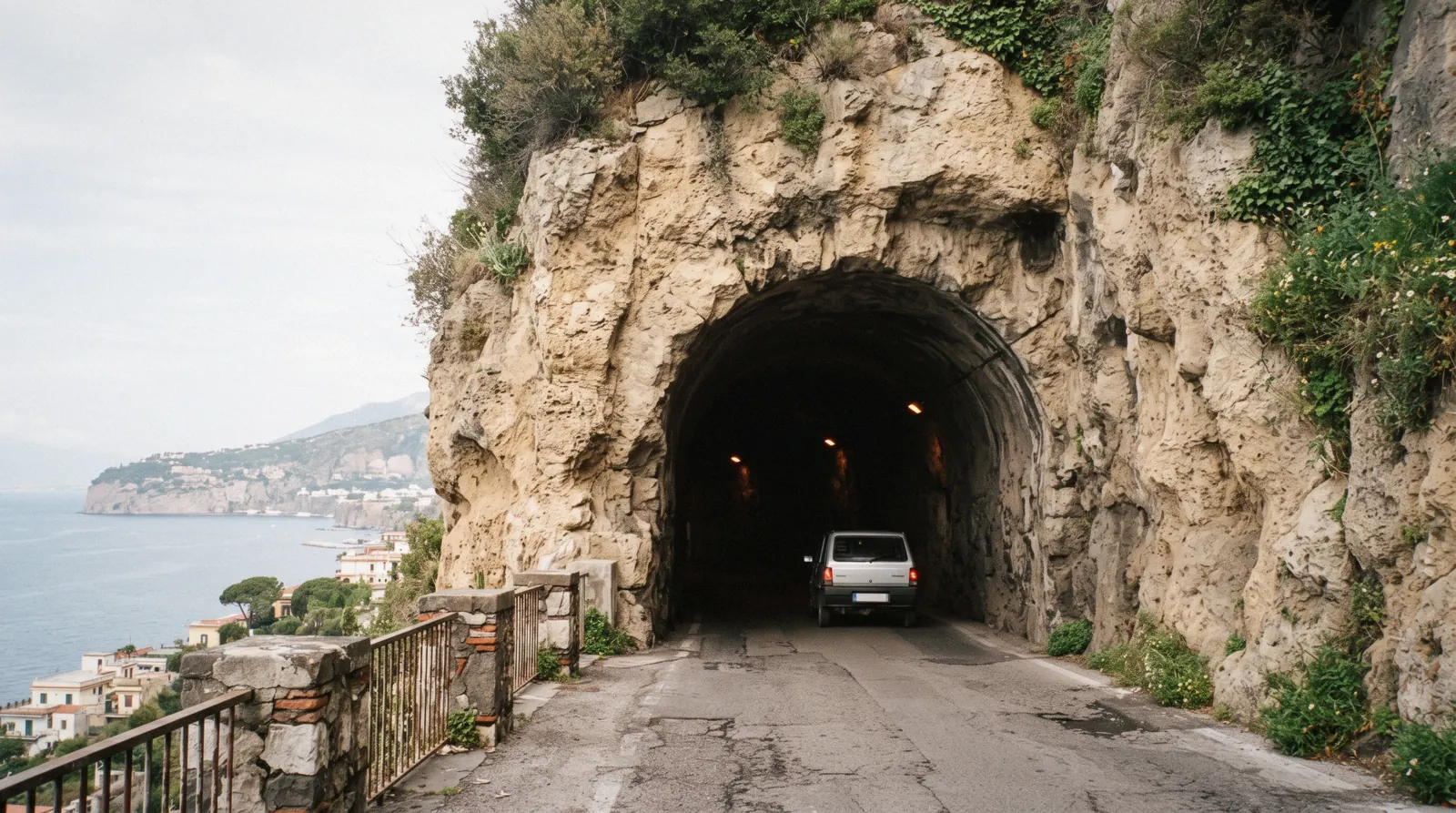
Parking in Sorrento: garages, blue lines and the ZTL
Parking in Sorrento is a solved problem if you accept one premise: the car parks in a garage and stays there. This page covers parking in Sorrento from the sources that can actually be checked, the two named central garages on their own websites, the blue-line street rules, the ZTL and the ferry-day arithmetic, and it is honest about the gaps, starting with the biggest one: free parking in Sorrento is, for practical purposes, not a thing. What you get instead is professional covered garages within a ten-minute walk of everything, one of which publishes a complete 2026 rate card, and a town whose own geography, a compact plateau, makes parking-once-and-walking the strategy that works.
Quick answer The garage answer, the blue-line rules, the ZTL, and the free-parking honesty
Park in a garage and walk: Fuorimura Parking, near the centre's south side, publishes full 2026 rates from $3.48 (€3) an hour and $27.80 (€24) for a 12-hour car day in low season, while Central Parking on Corso Italia states no prices online and quotes on contact. Street parking is blue-line and paid where it exists, free parking is effectively unavailable in the centre, and the ZTL restricted zones ring the historic core with camera enforcement.
Key takeaways
- The two garages compared from their own pages, with addresses, prices and walk times, are in the garages table
- The ferry-day arithmetic, garage day plus Capri crossing, is computed in the parking for a ferry day section
- If the car is not booked yet, the honest decision is on the do you need a car page first, because Sorrento is the town where going car-free is easiest
Where the car stands in Sorrento
Start with the geography that shapes everything else. Sorrento's centre is a plateau of a few streets, and the town was built long before the car: the lanes are narrow, the squares are pedestrian, and the two roads in and out run along cliffs. The town's visitors arrive overwhelmingly by train and ferry, and the parking stock exists for the minority who drive, sized for summer, priced like a scarce urban good. None of that makes parking in Sorrento bad; it makes it a solved problem with a price attached, and the price is the garage day rate.
The strategy that works is park once. Check in to the garage, walk or lift to the hotel, and leave the car until departure, because every Sorrento day out, Pompeii by train, Capri by ferry, the coast by bus or boat, starts on foot from the plateau, and the Amalfi-side drive is the one part of the peninsula a parked car actually improves. The one decision this page cannot make for you is whether the car should exist at all on this trip, and the do you need a car page makes that call honestly; the rest of this page assumes the answer was yes.
A word on what follows and where it came from. The garages below are covered from their own websites only, quoted as they state themselves, and where a garage publishes nothing, the page says so rather than filling the gap with forum arithmetic. Street-parking rules are the Italian national conventions applied to what the town's streets show; the town itself publishes no rate card for its meters that we could find, and that negative finding is printed where it belongs.
The garages, compared
Two central garages dominate the Sorrento parking question, and both are named by their own sites: Fuorimura Parking on the lane that runs off the centre's south side, and Central Parking Sorrento on the main street's eastern stretch. They cover the two useful models. Fuorimura is the transparent one: a covered above-ground facility that publishes its complete 2026 rate card online, books online with a 12-hour minimum, and states its walk times to the square, the station and the port. Central Parking is the classic Italian garage: indoor, guarded, video-surveilled, with a free on-demand shuttle and a staff who keep your keys, and a website that states no prices at all, so the rate is a phone call or an email away.
Both sit outside the ring of restricted-traffic streets, which matters more than it sounds: the ZTL cameras catch the driver who follows the satnav into the historic core, and both garages' own directions pages are written to route around that. The comparison table quotes each garage on its own terms, prices included where stated and not stated where not.
The two named garages, quoted from their own websites on 12 September 2026; dollar glosses computed at the ECB rate of 11 September 2026, and the absence of a published price is printed as the fact it is.
| Garage | Address | Prices | Access and booking | Walk |
|---|---|---|---|---|
| Fuorimura Parking | Via Fuorimura 35 | $3.48 (€3) per hour for a car in 2026; 12 hours $27.80 (€24) low season, $34.80 (€30) July to September; full table below | Online booking, 12-hour minimum, free cancellation to 7 days before; outside the ZTL; max height 2.7 m | About 4 min to Piazza Tasso, 8 min to the station, 10 min to the ferries, per the garage's own page |
| Central Parking Sorrento | Corso Italia 319 | Not stated on its site; quotes by phone on +39 081 807 1798; surcharge for oversized vehicles | Indoor, guarded, video surveillance, keys kept by staff; free on-demand shuttle with no fixed timetable | About 6 min walk to the centre, per the garage's own page |
How to read the pair: Fuorimura wins on paperwork, the published rates, the 2.7-metre height limit and the bookable 12-hour day, which is what a planner wants. Central Parking wins on position for the eastern hotels and on the shuttle, and its guarded, keys-deposited model is the town's traditional garage habit. Both are legitimate; the honest tiebreaker is that only one lets you price the trip before you arrive.
The published rates, season by season
Fuorimura's 2026 rate card is the only complete published price list for parking in Sorrento that this site has been able to verify against a garage's own page, so it is printed in full below and dated. Three structural facts sit behind the table. The hourly rate applies on-site without booking, while the online reservation requires a minimum 12-hour stay and forfeits unused hours rather than refunding them. Stays of three days or more take a 10 percent discount, and stays beyond 24 hours are calculated proportionally. And the season bands are sharp: the July-to-September peak adds a quarter to the shoulder rate, and the Christmas fortnight is priced at the peak again.
The categories matter because the peninsula drives tall vehicles: a 9-seat van or a Sprinter pays nearly double the car rate, and the motorcycle rate barely moves with the season. The garage states a maximum vehicle height of 2.7 metres, which clears a standard roof rack and not a tall camper, and LPG vehicles are allowed, which is worth knowing on a peninsula where rental fleets include them.
Fuorimura Parking's own 2026 rates for cars and motorcycles, 12-hour and 24-hour columns as the garage publishes them, read on 12 September 2026; dollar glosses at the ECB rate of 11 September 2026.
| Period (2026) | Car, 12 hours | Car, 24 hours | Motorcycle |
|---|---|---|---|
| 1 January to 30 June | $27.80 (€24) | $34.80 (€30) | $17.39 (€15) / $23.20 (€20) |
| 1 July to 30 September | $34.80 (€30) | $40.60 (€35) | $17.39 (€15) / $23.20 (€20) |
| 1 October to 31 October | $27.80 (€24) | $34.80 (€30) | $17.39 (€15) / $23.20 (€20) |
| 1 November to 23 December | $20.90 (€18) | $23.20 (€20) | $17.39 (€15) / $19.71 (€17) |
| 24 December to 3 January 2027 | $34.80 (€30) | $40.60 (€35) | $17.39 (€15) / $23.20 (€20) |
The van rates, same periods, are published on the garage's page too: a 7-seat van runs $34.80 (€30) for 12 hours low season and $40.60 (€35) in the peak, and a 9-seat van $46.40 (€40) and $52.20 (€45); the EV charging the garage offers carries no stated price. One worked example anchors the long-stay maths: three peak-season days at the 24-hour car rate, less the 10 percent three-day discount, comes to $93.90 (€81), which is the number to hold against a week's rental quote when the car question is still open.
Street parking and the blue lines
The Italian street-parking colour code governs Sorrento's kerbs as it governs every town's, and it is worth knowing as a system rather than as trivia. Blue lines are paid parking, ticket from the machine or the app, displayed on the dash. White lines are free parking where they exist, though in town centres they are frequently restricted to residents by signage rather than by colour alone, which is the trap: a white bay signed with a resident permit requirement is not free, it is a fine. Yellow lines are reserved, for residents, businesses or special categories, and are never for a visitor.
The honest Sorrento-specific part is thin, and deliberately so: the town publishes no rate card for its blue-line zones that we could find, so this page prints no invented meter price. What can be said from the street pattern is that the blue bays are scarce, short-stay and concentrated around the edges of the centre, that they empty and refill with the turnover of a resort town, and that for anything longer than a lunch they are the wrong tool, because the garage day rate exists precisely to replace the meter-and-refill treadmill. The practical rule: use blue bays for the arrival hour while you sort keys and luggage, photograph the bay's sign when you pay, and move the car to the garage.
Two national rules complete the primer for the tourist's own question about Italian parking law. Parking against the flow of traffic is illegal and enforced, night-time parking in unlit or unmarked spots is a bad idea rather than a technicality, and the disabled bay, marked with the international symbol, requires the permit, not the hazard lights, a tourist habit that draws some of the heaviest fines on the books.
The ZTL primer
The ZTL, the zona a traffico limitato, is the restricted-traffic zone that Italian towns draw around their historic cores, and it is the single most expensive piece of ignorance in Italian road travel. The scheme is simple: signage at the zone's entries states the hours and the exemptions, cameras read every plate that crosses, and fines are posted to the rental company or the registered owner months after the trip, with an admin fee added by the rental firm. Sorrento's historic core is a ZTL like every Campanian town's, and the two garages above both state their position outside it, because being outside it is the selling point.
The visitor's rules are short. Read the sign at the entry, every ZTL sign carries its active hours, and many zones are dormant most of the day and lethal at other hours. Do not follow the satnav blindly into a town centre, because the routing algorithm does not read ZTL signs; approach a town by its garage instead. Hotel guests are usually entitled to an exemption or an escort-in, but it is arranged by the hotel before the plate crosses the camera, so the move is to call ahead, not to negotiate at the bollard. And if a fine does arrive, the rental company's admin fee is often the larger half of the bill, which is one more reason the park-once-and-walk strategy wins the arithmetic on this page.
The same logic scales up the coast: the Amalfi-side towns run seasonal road access rules for the SS163 that are stricter than any ZTL, with plate-based alternating hours in summer, and the coast villages' parking is the scarce, expensive half of the region. That is the honest answer to whether parking is hard on the Amalfi Coast, and it is why the day trips from Sorrento are better taken by ferry and train; the Sorrento to Positano page times the alternatives.
Parking for a ferry day
The ferry-day question is the one the search engines actually get asked: can you park in Sorrento, leave the car, and boat to Capri for the day. The answer is yes, and the arithmetic is worth seeing whole, because it is the cost of the car's day off. The garage takes the car for the day, Fuorimura's 12-hour low-season rate of $27.80 (€24) or the peak $34.80 (€30) covers a full Capri day with margin, and the walk from either garage to the Marina Piccola pier is measured in minutes, ten per Fuorimura's own page, six from Central Parking to the centre plus the lift down. The crossing then costs the ferry's own fare, $25.50 (€22) each way on the standard boats, and the island adds its landing fee of $5.80 (€5) per person from April to October, charged on top of every crossing.
One worked day, per person, computed from those published figures: the ferry and landing fee come to $56.80 (€49) before any food, and the garage adds a share on top, $13.91 (€12) each at the low-season 12-hour rate split two ways, $17.39 (€15) each in the peak split two ways, or the full $34.80 (€30) for the solo driver paying the peak garage alone. The parking's share of the day is therefore roughly $14 to $35 per person on top of the ferry, which is not an argument against bringing the car; it is the number that makes the do you need a car decision honest.
Two practical notes close the section. Book the garage day ahead in July and August, because the 12-hour online product is exactly what sells out by mid-morning, and Fuorimura's own booking terms, 12-hour minimum, no refund on unused booked hours, reward deciding the return time before you drive in. And the cruise-passenger version of this question, parking near the dock for a day ashore, resolves the same way, at the same garages; the cruise port page carries the day-ashore routing.
Free parking, the honest answer
Is there free parking in Sorrento? Effectively no, and the honest page says so in one line before explaining the edge cases. The centre has no free public lot; the white-line bays inside the town are the exception rather than the rule and are frequently signed as resident-only, which turns the free bay into the fine; and the streets that look empty on a winter evening are empty because the enforcement cameras work in the off-season too. The searches that promise free parking near the centre usually surface white bays in the residential quarters above the town, a twenty-minute walk away, signed for permit holders, and the forum threads that recommend them age badly.
The two honest exceptions are seasonal and situational. Out-of-town free parking does exist on the white lines of the eastern and western residential approaches, where the sensible visitor checks the sign rather than trusting a pin, and the walk in from them is real, downhill one way. And some hotels outside the centre offer guest parking included in the rate, which is the subject of the section that follows and is included rather than free, a distinction the invoice eventually makes clear.
The planning takeaway is the one the whole page runs on: budget parking as a daily cost, from the garage day rate up, and let that number participate in the car decision. On a trip built around ferries and trains, the parking line is the quiet tax that the car-free itinerary never pays, and on the costs page it is the line most budgets forgot.
The hotel-parking alternative
The alternative to the public garage is the hotel's own arrangement, and it splits into three patterns worth knowing before booking rather than after. The cliff-edge and plateau hotels with their own grounds frequently offer on-site parking to guests, sometimes included, more often priced per night, and the cliff-edge properties' garages are usually lifts and ramps underground, sized to their room counts. The town-centre hotels without grounds hold agreements with the named garages, so the bill arrives as a garage line at checkout, often at a rate close to the garage's own. And the rural and hillside properties above town, the agriturismo belt, offer open-air parking that is genuinely free because the land is their own, at the cost of a drive or a bus to every town evening.
The booking discipline that saves the money is one question at reservation time: what does parking cost, and where does the car sleep? Ask it with the car's dimensions, because the 2.7-metre class of answers, roof boxes included, applies at hotel ramps too, and no Sorrento hotel publishes a rate card that this site could verify, so the honest line is that hotel parking prices are not stated anywhere central and are quoted per property. The where to stay page groups the neighbourhoods so the parking question can be asked of the right addresses.
One final structural note: the hotel option does not remove the ZTL question, it relocates it. A hotel inside the restricted core arranges the guest's plate with the authorities in advance, which is exactly the call-ahead move the ZTL primer prescribes, and it is the reason the drive-in sometimes goes smoothly at a hotel address and badly at a self-guided one. Book the hotel before you drive, not after. When the town part of the plan is settled, the Sorrento city guide front page keeps the rest of the site one click away.
The garages on a map
The two named garages pinned at their verified positions, with the three orientation points a driver actually navigates by: the square, the station and the ferry pier.
Garage positions verified against OpenStreetMap data via Nominatim on 12 September 2026; the garages' own pages publish no coordinates. Piazza Tasso, the station and the pier reuse the positions already mapped on the getting around page.
Where the car decision goes next
Three pages carry the next decisions: whether the car should exist, what the trip costs with it, and where the room sits relative to the garage.
Do you need a car in Sorrento
The honest case for and against the car on a peninsula trip, before the garage bill is agreed to.
The decision this page pricesWhat Sorrento costs
Every named price on the site with its source, so the parking line sits beside the ferries and the tax.
The budget lineWhere to stay
The neighbourhoods grouped, so the where-does-the-car-sleep question is asked of the right properties.
The hotel-parking questionParking in Sorrento: questions
Is there free parking in Sorrento?
Effectively no. The centre has no free public lot, the white-line bays are scarce and often signed resident-only, and the residential-edge free bays cost a real walk and a sign-reading habit. The honest plan is to budget a garage day rate, which starts at $20.90 (€18) for a 12-hour low-season car day at the one garage that publishes rates, and treat anything free as a lucky exception rather than a plan.
Where can I park in Sorrento?
In one of the two central garages, Fuorimura on Via Fuorimura 35 and Central Parking on Corso Italia 319, both outside the ZTL and within a ten-minute walk of the centre, or at your hotel's own arrangement if it has one. The blue-line street bays exist for the arrival hour but are the wrong tool for a day, let alone a stay. The comparison table above quotes each garage from its own page.
How much does garage parking cost in Sorrento?
Only one garage publishes: Fuorimura's 2026 card runs $3.48 (€3) an hour for a car, $27.80 (€24) for a 12-hour low-season day, $34.80 (€30) in the July-to-September peak, and three-day stays take 10 percent off. Central Parking states no prices online and quotes by phone. Van and motorcycle rates sit in the season table above.
Where do I park for a ferry day to Capri?
At a garage near the centre, then walk or take the lift to the Marina Piccola pier: Fuorimura's own page times the walk at about ten minutes. The worked day in the ferry-day section above comes to roughly $56.80 (€49) per person in ferry and landing fee alone, plus the garage day, which is why the ferry-and-train itinerary without the car costs the day nothing extra.
What are the parking rules for tourists in Italy?
The colour code is the system: blue lines are paid, white lines are free where genuinely available, yellow is reserved, and resident-signed bays are neither free nor yours. Read every ZTL entry sign before crossing, because camera fines arrive months later through the rental company with an admin fee on top, and a hotel inside the zone arranges your plate in advance if you call ahead. The primer above walks each rule.
Is long-term parking available in Sorrento?
Yes at Fuorimura, which books online from 12 hours up to 31 days, applies its 10 percent discount at three days or more, and calculates stays beyond 24 hours proportionally; three peak-season days at the 24-hour car rate come to $93.90 (€81) with the discount. Central Parking's long-stay terms are not stated online, so they are a phone question on +39 081 807 1798.
Is it hard to find parking on the Amalfi Coast?
It is the hardest parking in the region, which is the quiet case for parking in Sorrento instead: the coast villages have handfuls of garages at peak-season prices, and the SS163 runs summer access rules with plate-based hours on top. The workable pattern is the one this page is built on, the car parked once on the Sorrentine side and the coast days taken by ferry, with the Sorrento to Positano page carrying the crossing times.
Parking In Sorrento on film
Three walk-throughs verified on YouTube: what the place actually looks like before you book anything.
Tips for Driving on the Amalfi Coast
Verified via oEmbed (Brandin Stoesz); matched query 'parking in sorrento italy'.
Video: Brandin StoeszThe Don'ts of Sorrento, Italy & The Isle of Capri
Verified via oEmbed (Wolters World); matched query 'parking in sorrento italy'.
Video: Wolters World*NEVER* do THIS driving in Italy when Renting a Car
Verified via oEmbed (Gregor Brown); matched query 'parking in sorrento italy'.
Video: Gregor BrownVideos load from YouTube only when you press play.
We may earn a commission if you book through one of our links, at no extra cost to you. Full affiliate disclosure