 Sorrento City Guidebook
Sorrento or the Amalfi Coast: Where to Base the Trip
Last reviewed 2026-09-12
The question of Sorrento or Amalfi Coast decides the whole shape of a Campania trip before a single night is booked, and the internet answers it with vibes: dramatic cliffs, lemon groves, a film set. The decision is actually about transport, tax, season and the clock, and those can be settled with figures. Sorrento is a working town of about sixteen thousand people on the north edge of the Sorrentine peninsula, administratively and geographically outside the Amalfi Coast, which begins across the headland at Positano. The coast is a string of cliff villages, Positano, Amalfi, Ravello, connected by one road and one ferry line, with no railway anywhere on it. Sorrento has the train, the bigger ferry schedule and the year-round town life; the coast has the postcard and the price to match. This page runs the comparison across seven dimensions, gives a verdict on each, names the do-both minimum, and prints the honest concessions where the other side simply wins. The base decision feeds every later one, from where to stay in Sorrento to which day trips from Sorrento fit, and the ferry mechanics between the two are timed on the Sorrento to Positano page. The Sorrento city guide homepage pulls the rest of the site together.
Quick answer The verdict, the seven dimensions, and the do-both minimum
Base in Sorrento if the trip is built around movement: it is the only railhead on the peninsula, its ferries reach Capri, Naples, Positano and Amalfi, and its prices and tax bands run lower. Base on the Amalfi Coast if the trip is built around the place itself and you accept one road, one ferry line and a November-to-March shutdown for the privilege. Most first trips fit Sorrento better, and the honest correction is that Sorrento is not on the Amalfi Coast, it is the town next door with better transport.
Key takeaways
- Transport decides it for most itineraries: the train terminates in Sorrento, the coast towns have none, and the coast ferries run a full timetable only from 01 April to 03 November
- Tax is a real line: Sorrento charges $3.48 to $5.80 (€3 to €5) a hotel night, Positano charges up to the same but only from April to October, and the full bands are compared on the costs page
- The do-both minimum is three nights: two in Sorrento to run the day trips, one on the coast to keep the evening, with the ferry-ticket product covering the Sorrento to Positano to Amalfi line
- The coast concession is printed plainly: Positano wins the view, and it is not close
What the two bases actually are
Sorrento sits on a cliff-top plateau facing the Bay of Naples, a compact grid of streets with a working centre that does not close when the boats stop. Its transport position is the argument: the Circumvesuviana railway terminates here from Naples, ferries and hydrofoils leave Marina Piccola for Capri, Naples, Positano and Amalfi, and the SITA buses climb over the headland to the coast villages. The town's own sights are free and walkable, and its hotel stock runs from small B&Bs to cliff-edge five-stars.
The Amalfi Coast is not one town but a chain of them, Positano, Praiano, Amalfi, Atrani, Minori, Ravello, draped down the south side of the same peninsula. What reads as one destination is a set of villages stitched together by the SS163 coast road above the sea and by the seasonal ferry line that threads them. There is no train station anywhere on the coast, which is the single fact most base decisions turn on. Everything arriving by rail arrives at Sorrento or Naples, and everything else is road or boat.
So the comparison is not town versus town. It is a transport hub with a beach problem against a picture with a transport problem.
The seven dimensions at a glance
The seven dimensions that decide the base question, with a verdict on each row. Figures come from the operator and council sources dated on this site, the ferry season and fares from the NLG timetable read on 12 September 2026, the tax bands from the two comunes' own notices.
| Dimension | Sorrento | The Amalfi Coast | Verdict |
|---|---|---|---|
| Transport | Rail terminus, two ports, SITA buses, the largest ferry schedule on the peninsula | No railway; one coast road and a seasonal ferry line | Sorrento |
| Price | Tourist tax $3.48 to $5.80 (€3 to €5) a night by hotel category, seven-night cap | Positano up to $5.80 (€5) in five-star, $2.90 (€2.50) in rentals, charged April to October only; Amalfi publishes its bands as PDF deliberations, figures not stated here | Sorrento, narrowly |
| Evenings | A resident town: the squares and bars run all year | Village evenings, brilliant in season, thin from November to March | Sorrento off season, the coast in season |
| Beach access | Rocky platforms and pebble strips below the cliffs | Sand and pebble beaches under the towns themselves | The coast |
| Day-trip reach | Pompeii by train, Capri and Naples and Ischia by ferry, the coast by boat or bus | The coast itself is the trip; everything else needs a change in Sorrento | Sorrento |
| Crowds | Day-tripper flood each morning, empty by evening | The day-tripper flood stays, compressed into four villages | Draw, by season |
| Season | Year-round town with a winter visitor season of its own | The ferry timetable runs 01 April to 03 November 2026; winter service is two weekend sailings a day | Sorrento outside summer |
Ferry season and winter frequency per the NLG route page, fetched 12 September 2026. Positano's tax bands per the Comune di Positano service page, deliberation 181 of 19 November 2025. Sorrento's bands per the council's 2026 notice. The dimensions are unpacked in the sections below.
Transport and day-trip reach: the dimensions that decide it
Put the two transport dimensions together, because they argue the same way. Sorrento is the peninsula's railhead: the Circumvesuviana from Naples ends here, which means Pompeii sits one unbroken train ride away and the arrival from Naples needs no change at all. From Marina Piccola, the ferries reach Capri in the season timetable, Naples and Ischia on their own lines, and the coast villages on the Positano and Amalfi route. A base in Sorrento runs four different day trips on four different carriers, which is what a base is for.
The coast runs on one road and one boat line. The SITA bus and the ferry both work, and for a coast-internal day they work well, but every off-coast trip, Pompeii, Vesuvius, Capri, Naples, begins with the same change in Sorrento or a long road detour through the mountains. Readers who picture themselves visiting Pompeii and Capri while sleeping in Positano are picturing two extra legs a day.
The verdict, dimension by dimension: transport, Sorrento, and it is not a narrow call. Day-trip reach, Sorrento, for the same reason. If the trip's centre of gravity is the coast itself, the coast wins without needing a road, because then the change problem never arises. That is the real question the two dimensions ask: what does this trip move towards? The things to do index sorts the town-side options, and the Amalfi Coast day trip page times the coast run from Sorrento.
Price: the tax line and what it reveals
Sleeping costs more on the coast at equal comfort, and the tourist tax is the line that shows the pattern in miniature. Sorrento charges €3, €4 or €5 per person per hotel night by category, a $3.48 to $5.80 (€3 to €5) gloss, capped at seven nights. Positano's 2026 bands, confirmed by the comune in February 2026, run from $2.90 (€2.50) in B&Bs and holiday homes to $5.80 (€5) in the five-stars, and the interesting detail is the season: Positano levies the tax only on stays between 1 April and 31 October, children up to ten exempt. Amalfi's schedule is published as council deliberations in PDF form, last tariff update February 2022, so this page prints not stated rather than a figure it cannot read.
A seasonal tax is the town telling you what its year looks like, and it is the bridge to the two soft dimensions. Evenings: Sorrento is a resident town whose bars, squares and restaurants run all twelve months, while the coast's hospitality stock thins visibly from November to March, our reading of the two towns' calendars rather than anyone's published statistic. Season: the ferry line that stitches the coast together runs daily from 01 April to 03 November 2026, and its winter schedule is a single midday sailing on Saturdays and Sundays. A November coast base without a car is a base with two buses a day in each direction. None of this makes the coast worse; it makes it seasonal, which is only a problem for trips that are not.
The full per-day arithmetic, meals included, lives on the costs page.
Beach access, crowds, and the concession
Beach access goes to the coast, honestly. Sorrento's shore is rocky platforms and pebble strips reached by lifts and staircases below the cliff, with the swimming coves catalogued on the beaches page; it is swimmable and scenic, and it is not sand. Positano's Spiaggia Grande sits under the town, Amalfi has its beach at the harbour mouth, and the coast's beach habit is walk-in. If the trip's afternoons are meant to be horizontal, the coast wins the dimension and no transport argument undoes it.
Crowds are a draw, and the mechanism matters more than the count. Sorrento's day-trippers arrive every morning by train and ferry and drain away by evening, so the town runs in two modes: busy square at noon, resident town at night. The coast's crowds arrive and stay put, compressed into four villages strung along one road, which is why Positano at midday in July is a queue with a view. Our reading, labelled as such, since neither comune publishes hourly visitor counts: the coast feels busier at any given hour, Sorrento feels busy in waves.
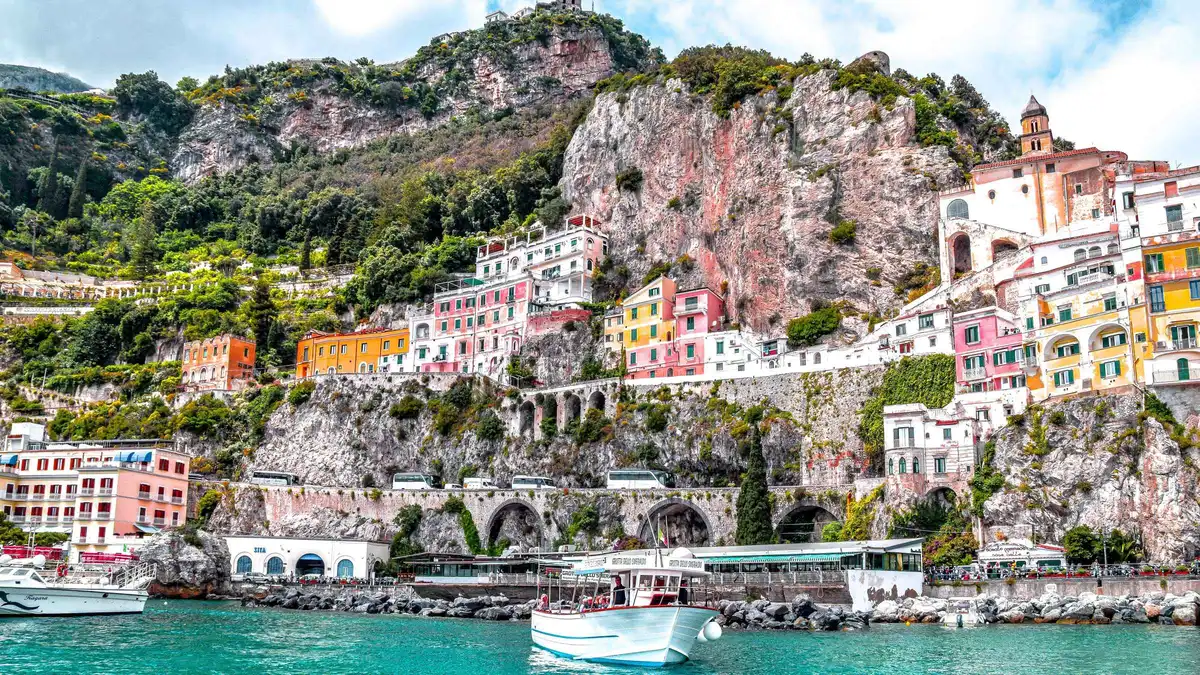
And the concession that earns the page its honesty: the coast is prettier. Asked which is prettier, Positano or Sorrento, the answer is Positano, and it is not close, because Positano is a vertical village stacked on a cliff and Sorrento is a town that happens to stand above the sea. If the traveller's memory of the trip will be the view from a terrace at dusk, that memory is worth the transport tax, and the rest of this page exists for everyone whose trip has trains in it. A middle path exists too: the quiet peninsula towns of Sant'Agnello and Massa Lubrense country, and the coast's own evening, which the coast day page explains how to buy without sleeping there.
The verdict: pick Sorrento if, pick the coast if
The two lists compress the seven dimensions into the only question that matters, which is what the trip is actually for. The transport dimensions, the price line and the season clock all point one way; the view and the beaches point the other; and no formula resolves a traveller's own weighting.
- Pick Sorrento if the trip includes Pompeii, Vesuvius, Capri or Naples, because every one of them runs better from the railhead
- Pick Sorrento if arrival or departure runs through Naples, because the train and ferry set needs no road
- Pick Sorrento if the trip falls outside May to October, when the coast's ferry line and much of its hospitality close down
- Pick Sorrento if the budget is counted in evenings as well as nights: the year-round town eats and drinks cheaper at equal quality, and the eating hub lists the range
- Pick the coast if the trip is the coast: four nights in Positano or Amalfi with no timetable but the boats
- Pick the coast if afternoons are beach afternoons and the sand has to be walk-in
- Pick the coast if the date is a celebration and the view is the point, and the change-in-Sorrento problem will never be felt
The do-both minimum, and what it costs
The comparison is rarely either-or in practice, because the ferry line lets one trip hold both. The workable minimum is three nights: two based in Sorrento to run the trains and the Capri boats, then one night across the headland to keep the coast's evening, which is the part day trips miss. The crossing itself is the cheapest line on the itinerary: the NLG ferry from Sorrento to Positano is $24.90 (€21.50) one way, about thirty-five minutes, on a summer timetable that runs from 01 April to 03 November 2026 with six sailings a day from Sorrento. The ferry-ticket product covers the Sorrento, Positano and Amalfi line in one booking, which suits a trip that ends on the coast rather than returning.
Two rules keep the do-both day honest. Book the Positano return before the trip, because the company keeps no ticket office in Positano itself, so the second half of the ticket is bought at a machine or on a phone, not at a window. And carry the luggage reality: the ferry charges $5.80 (€5) per piece each way, and the coast villages' staircases make hard-shell luggage a public nuisance. The full crossing arithmetic, every sailing time and the two-hours-in-Positano question, is timed on the Sorrento to Positano page, and the lodging side of the split is set out on where to stay.
The ferry ticket that makes do-both work
One card, because the do-both plan needs exactly one product: the ferry ticket covering the Sorrento, Positano and Amalfi line, listed at $61 on the platform on 12 September 2026. The DIY fare comparison is on the coast transport pages this guide links throughout.
 from $61
Ferry Ticket from Sorrento to Amalfi and Positano
A ferry-ticket product covering the Sorrento–Positano–Amalfi line for readers doing the coast without a tour.
Check AvailabilityPrices, ratings and details are the platform's own, checked in Q3 2026; dollar figures are the listed prices — the platform bills in your account's currency.
Sorrento or Amalfi Coast: the questions behind the search
Is it better to stay on the Amalfi Coast or in Sorrento?
Better depends on what the trip moves towards, and the seven dimensions above are the tally. Sorrento wins transport, day-trip reach and season outright, and price narrowly; the coast wins beaches and the view, and evenings in season. For a first trip with trains in it, Sorrento is the better base. For a trip whose whole purpose is the coast, the coast is the better base and the transport argument is irrelevant.
Is Sorrento actually on the Amalfi Coast?
No. Sorrento sits on the north side of the Sorrentine peninsula, facing the Bay of Naples, while the Amalfi Coast is the south-facing stretch that starts at Positano. Administratively they are separate comunes and geographically they face different seas. The ferry across the headland connects them in about thirty-five minutes in season, which is why the two are so often confused as one destination.
Which is prettier, Positano or Sorrento?
Positano, and the page does not hedge: a vertical village stacked down a cliff in pastel tones is a different visual category from a cliff-top town, however pleasant Sorrento's gardens and squares are. The honest follow-up is what the beauty costs in logistics, one road, no railway, a seasonal ferry line, which is the trade the seven dimensions above price out.
How far is Sorrento from the Amalfi Coast?
Closer than the maps suggest and slower than the distance implies. Positano is the first coast village and the ferry crossing takes about thirty-five minutes in season; Amalfi sits a further leg up the coast on the same NLG line. By road the single SS163 highway carries everything, and its season traffic is the reason the boat usually wins. The sailing times, all of them, are printed on the coast transport page.
Can you visit the Amalfi Coast while staying in Sorrento?
Yes, and it is the standard shape of a Sorrento trip: ferry out in the morning, ferry back in the evening, with the coast day page timing the Positano and Amalfi run. The two constraints are the ferry season, which runs to 03 November 2026, and the return clock, since the last Positano departure back is 17:45. The winter fallback is the SITA bus.
How many nights do you need to do both Sorrento and the Amalfi Coast?
Three is the honest minimum: two in Sorrento to run the day trips, one on the coast to keep its evening, with the luggage-light ferry move between them. Fewer nights than that and the do-both plan collapses into a day trip, which is a fine trip, just not the same one. A week splits four and three comfortably.
Sorrento Or Amalfi Coast on film
Three walk-throughs verified on YouTube: what the place actually looks like before you book anything.
Sorrento or Positano or Amalfi: Where to Stay on the Amalfi Coast
Verified via oEmbed (The World Was Here First); matched query 'sorrento or amalfi coast where to stay'.
Video: The World Was Here FirstWhere to STAY on Amalfi Coast Italy ? Positano Amalfi Sorrento or Naples | Low, Mid & High Budget
Verified via oEmbed (Brown Expats); matched query 'sorrento or amalfi coast where to stay'.
Video: Brown ExpatsWhere to Stay On the Amalfi Coast? 4 Best Areas & Towns 🇮🇹
Verified via oEmbed (Destination Well Known); matched query 'sorrento or amalfi coast where to stay'.
Video: Destination Well KnownVideos load from YouTube only when you press play.